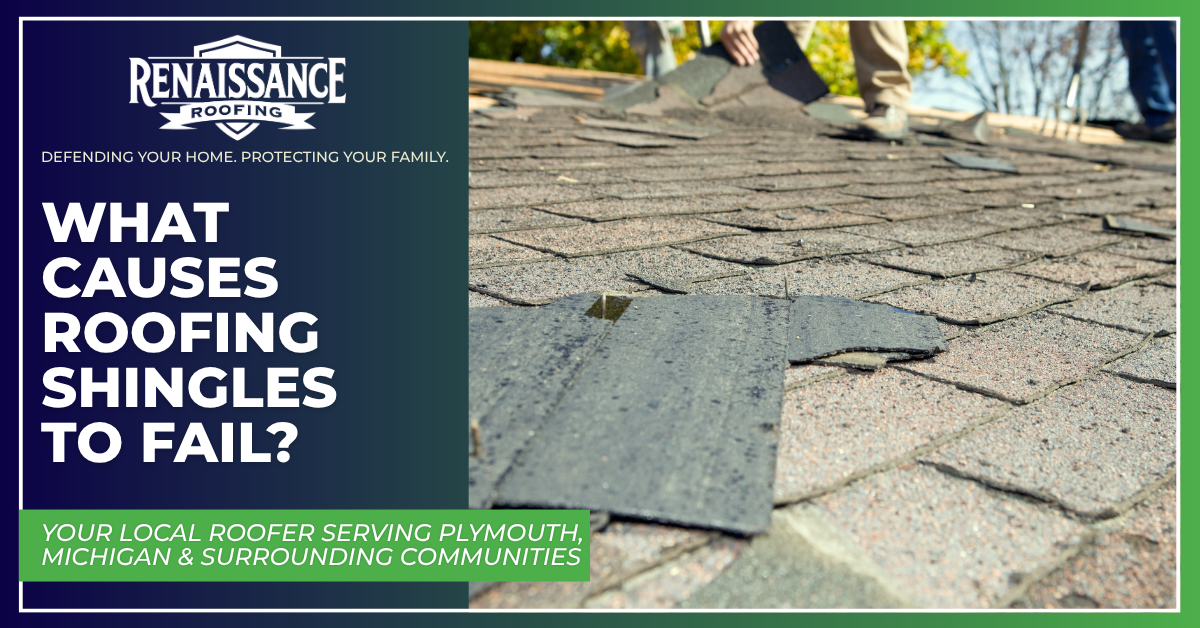
What Causes Roofing Shingles To Fail?
Roofing shingles usually fail because of a combination of age, weather exposure, poor installation, ventilation problems, storm damage, algae growth, and low-quality materials. In Michigan, roof shingles face a tough mix of snow, ice, wind, rain, humidity, and rapid temperature changes. Over time, those conditions can weaken the shingles, loosen the seal, wear away protective granules, and expose the roof system underneath.
For homeowners in Plymouth, Canton, Novi, Farmington, Ann Arbor, and surrounding Southeast Michigan communities, shingle failure is more than a cosmetic issue. Once shingles stop doing their job, water can work its way into the roof deck, attic, insulation, walls, and ceilings. That is why choosing the right roofing company and the right shingle system matters from the beginning.
Renaissance Roofing helps homeowners understand not only when a roof needs attention, but also why certain shingles last longer than others. Two of the most trusted names in residential roofing are GAF and CertainTeed. Both manufacturers offer shingle products designed to address common causes of roof failure, including wind uplift, algae staining, impact damage, delamination, and poor installation.
Why Shingle Failure Happens Over Time
Even a high-quality asphalt shingled roof is constantly exposed to the elements. Your roof takes the first hit from sun, wind, rain, hail, snow, tree debris, and ice. Day after day, the materials expand, contract, dry out, and age.
Most roof failures do not happen overnight. Instead, small problems build slowly. A few missing granules turn into exposed asphalt. A weak seal turns into wind-lifted shingles. Poor attic ventilation creates heat and moisture buildup. Eventually, the roof starts showing visible signs such as curling or cracked shingles, leaks, dark streaks, or missing tabs.
The good news is that many of these problems can be reduced with proper installation, quality roofing materials, and regular inspections.
-
Poor Installation Is One of the Biggest Causes of Shingle Failure
A roofing shingle is only as good as its installation. Even premium shingles can fail early if the installer uses poor nailing patterns, places nails too high or too low, skips starter shingles, ignores flashing details, or fails to install proper ventilation.
One of the most common installation-related issues is incorrect nailing. Nails need to land in the proper nailing zone so the shingle can hold securely against the wind. If nails are overdriven, underdriven, angled, or placed outside the correct area, the shingle may not stay locked down.
This is one reason GAF developed its StrikeZone® nailing area on Timberline HDZ® shingles. GAF describes StrikeZone as the industry’s largest nailing zone, powered by LayerLock® Technology, and paired with Dura Grip™ sealant to help shingles stay in place under high-wind conditions.
CertainTeed also emphasizes installation accuracy. Its Landmark PRO shingles feature NailTrak®, which is designed to help contractors place fasteners correctly, along with QuadraBond® layering and CertaSeal™ adhesive technology to support long-term performance.
For homeowners, the takeaway is simple: shingle technology helps, but installation still matters. A quality roofing company should follow manufacturer specifications, use the correct accessories, and install the roof as a full system.
-
Wind Damage Can Break the Shingle Seal
Michigan storms can bring strong wind gusts, especially during spring and summer storm seasons. Wind damage happens when air gets underneath the edge of a shingle and breaks the adhesive seal. Once that seal breaks, the shingle can lift, crease, crack, or tear away completely.
You may notice wind damage if you see:
- Missing shingles
- Lifted shingle edges
- Creased shingles
- Exposed nail heads
- Loose shingles in the yard
- Leaks after a storm
GAF Timberline HDZ shingles are designed with LayerLock® Technology, StrikeZone®, and Dura Grip™ sealant to help resist wind uplift. GAF also notes that Timberline HDZ shingles are eligible for the WindProven™ Limited Wind Warranty when installed with the required qualifying accessories.
CertainTeed shingles also include wind-resistance features. Landmark PRO uses CertaSeal™, an adhesive sealant strip designed to help shingles resist uplift when properly sealed.
Wind failure is one of the reasons roof inspections after major storms are so important. A roof can look mostly fine from the ground while still having lifted shingles that are no longer sealed correctly.
-
Granule Loss Weakens the Shingle’s Protective Surface
The granules on asphalt shingles are not just there for color. They protect the asphalt layer from ultraviolet light, impact, weathering, and fire exposure. When granules wear away, the asphalt underneath becomes more vulnerable to drying, cracking, and deterioration.
Granule loss can happen because of:
- Normal aging
- Hail or storm impact
- Foot traffic
- Poor-quality shingles
- Aggressive pressure washing
- Improper roof drainage
- Tree branches rubbing against the roof
A small amount of granule shedding is normal on a newer roof. However, large amounts of granules in the gutters or downspouts can signal that the shingles are wearing down.
GAF Timberline HDZ shingles feature ceramic-coated granules, engineered asphalt, a high-strength fiberglass core, and Dura Grip adhesive. CertainTeed’s Landmark PRO shingles use a fiberglass base and protective outer layer designed for durability and impact resistance.
When granule loss becomes severe, repair may not be enough. At that point, a roof replacement may be the best long-term solution.
-
Algae Growth Causes Dark Streaks and Premature Aging
Blue-green algae often cause those dark streaks you see on many roofs. Algae does not usually create an immediate leak, but it can make a roof look older, reduce curb appeal, and contribute to moisture-related wear over time.
Algae growth is common in humid climates and shaded areas. Homes with overhanging trees, poor sunlight exposure, or damp roof surfaces are more likely to show streaking.
Both GAF and CertainTeed offer algae-resistant shingle technologies. GAF Timberline HDZ shingles include algae protection, and retail product information notes that StainGuard Plus™ Algae Protection Limited Warranty is available on certain Timberline HDZ shingles. GAF also describes time-release algae-fighting technology in Timberline UHDZ materials.
CertainTeed offers StreakFighter® algae resistance on Landmark PRO shingles, helping protect against black streaking caused by algae growth. CertainTeed also describes CertainTeed’s Belmont and Grand Manor shingles as algae-resistant.
For Michigan homeowners, algae resistance is a valuable feature because moisture, shade, and seasonal humidity can all contribute to staining.
-
Hail and Impact Damage Can Crack or Bruise Shingles
Hail damage is not always obvious from the ground. A shingle may look intact, but the impact can bruise the asphalt, knock off granules, or weaken the fiberglass mat. Over time, that damaged area may become a leak point.
Common signs of impact damage include:
- Round dark spots on shingles
- Missing granules
- Dents on vents, gutters, or flashing
- Cracked shingles
- Soft bruised areas on the shingle surface
Impact-resistant shingles are designed to withstand hail and flying debris better. GAF Timberline UHDZ with UltraMat™ uses high-performance fiberglass mat technology and achieves a UL 2218 Class 4 impact-resistance rating. GAF also says UltraMat strengthens the shingle core to help resist tough impacts.
CertainTeed offers impact-resistant options as well. Landmark PRO is described as a UL 2218 Class 3 impact-resistant shingle, while CertainTeed describes Grand Manor and Belmont as UL 2218 Class 4 impact-resistant shingles.
Impact resistance does not make a roof indestructible. However, it can give homeowners added protection in areas that experience hail or severe storms.
-
Shingle Delamination Can Expose the Roof to Weather
Delamination happens when layers of a laminated asphalt shingle separate. This can make shingles look curled, split, or uneven. More importantly, it can reduce the roof’s ability to shed water properly.
CertainTeed directly addresses this issue with QuadraBond® technology on Landmark PRO shingles. CertainTeed explains that Landmark PRO is a laminate shingle made from two layers held together with adhesive, and if that bond fails, the layers can separate, leaving the roof looking damaged and exposed.
GAF’s Timberline HDZ shingles use LayerLock® Technology, which mechanically fuses the common bond between overlapping shingle layers. GAF also describes a dual-phase shingle-to-shingle seal using Dura Grip™ sealant and the StrikeZone nailing area.
For homeowners comparing shingles, this matters. A stronger bond helps the shingles behave as a single, durable roofing component rather than separate layers that can pull apart under stress.
-
Poor Attic Ventilation Can Cook Shingles From Below
Many homeowners only think about what happens on top of the roof. However, what happens under the roof can be just as important.
Poor attic ventilation traps heat and moisture. In summer, excessive heat can bake the underside of the roof deck and accelerate shingle aging. In winter, trapped warm air can contribute to the formation of ice dams. Moisture buildup can also damage decking, insulation, and structural components.
Signs of ventilation problems may include:
- Hot upstairs rooms
- Ice dams in winter
- Mold or mildew in the attic
- Rusted nails in the attic
- Wavy or deteriorated roof decking
- Shingles aging faster than expected
A good roofing company should evaluate ventilation as part of the roof system. Replacing shingles without correcting ventilation problems can shorten the life of the new roof.
-
Ice Dams Can Force Water Under Shingles
In Southeast Michigan, ice dams are a major cause of shingle and roof system failure. Ice dams form when heat escapes into the attic, melts snow on the roof, and then that water refreezes near the colder eaves.
As ice builds up, water can back up under the shingles. Shingles are designed to shed water downward, not hold back standing water. Once water backs up, it can seep beneath the shingles and into the roof deck.
The best defense against ice dams includes:
- Proper attic insulation
- Balanced ventilation
- Ice and water shield
- Correct flashing
- Quality installation at eaves, valleys, and penetrations
This is another reason a roof should be treated as a complete system. Shingles matter, but underlayment, ventilation, flashing, and installation details all work together.
-
Flashing Failures Can Make Good Shingles Look Bad
Sometimes shingles are not the main problem. Flashing is the metal or waterproofing material installed around chimneys, walls, valleys, skylights, vents, and roof transitions. When flashing fails, water can leak into the home even if the shingles are still in decent shape.
Common flashing problems include:
- Rusted or loose flashing
- Poorly sealed pipe boots
- Improper chimney flashing
- Damaged step flashing
- Missing kick-out flashing
- Reused flashing during roof replacement
A roof replacement should include a thorough inspection of all flashing details. If a contractor installs new shingles around old, failing flashing, the roof may still leak.
-
Choosing the Wrong Shingle for the Home Can Lead to Problems
Not every roof needs the same shingle. Some homeowners want a reliable architectural shingle. Others want premium curb appeal, stronger impact resistance, or enhanced algae protection.
GAF and CertainTeed both offer multiple shingle lines for different needs.
GAF Shingle Features That Help Reduce Failure
GAF Timberline HDZ shingles are popular because they combine installation accuracy, wind resistance, algae protection, and a dimensional look. Key features include LayerLock® Technology, StrikeZone® nailing area, Dura Grip™ sealant, and eligibility for the WindProven™ Limited Wind Warranty when installed as required.
GAF Timberline UHDZ with UltraMat™ adds Class 4 impact resistance through high-performance fiberglass mat technology. This makes it a stronger option for homeowners who want enhanced storm protection.
CertainTeed Shingle Features That Help Reduce Failure
CertainTeed Landmark PRO shingles include NailTrak® for installation accuracy, QuadraBond® layering to help prevent delamination, CertaSeal™ to help resist wind uplift, and StreakFighter® algae resistance. CertainTeed also describes Landmark PRO as a UL 2218 Class 3 impact-resistant shingle.
CertainTeed Grand Manor and Belmont are premium shingles that offer Class 4 impact resistance and algae resistance, while also delivering a high-end slate-inspired appearance.
The right choice depends on your home, budget, roof design, and performance priorities.
How Homeowners Can Prevent Premature Shingle Failure
While no roof lasts forever, homeowners can take smart steps to reduce the risk of early shingle failure.
Start with regular roof inspections. A professional inspection can catch lifted shingles, damaged flashing, worn pipe boots, storm damage, ventilation concerns, and early signs of leaks before they turn into expensive repairs.
Keep gutters clean, too. Clogged gutters can cause water to back up along the roof edge, increasing the risk of fascia damage, ice dams, and water intrusion.
Trim overhanging branches. Tree limbs can scrape shingles, drop debris, hold moisture, and increase the risk of impact damage during storms.
Avoid walking on the roof unless necessary. Foot traffic can loosen granules, damage shingles, and create unnecessary wear.
Most importantly, work with an experienced roofing company. Proper installation, correct ventilation, quality materials, and manufacturer-approved methods all play a major role in roof longevity.
When Should You Repair Shingles vs. Replace the Roof?
A roof repair may make sense if the damage is isolated. For example, a few missing shingles, a small flashing issue, or a minor pipe boot leak may be repairable.
However, replacement may be the better option if:
- The roof is near the end of its lifespan
- Shingles are curling across large areas
- Granule loss is widespread
- Multiple leaks are present
- Storm damage affects several slopes
- The roof has poor ventilation and aging materials
- Repairs are becoming frequent
A professional roofing inspection can help determine whether repair or replacement is the smarter investment.
Why Renaissance Roofing Focuses on Long-Term Roof Performance
A roof should do more than look good on installation day. It should protect your home from Michigan’s wind, rain, snow, ice, and seasonal temperature swings.
That is why Renaissance Roofing helps homeowners choose roofing materials that match their home’s needs and budget. Whether you are comparing GAF shingles, CertainTeed shingles, impact-resistant options, algae-resistant shingles, or complete roof replacement systems, the goal is to install a roof that performs well for years.
For homeowners in Plymouth, Canton, Novi, Farmington, Ann Arbor, and nearby communities, shingle failure often starts with small signs. The earlier you address those signs, the easier it is to protect your home.
0 Comments